
Below are links to PDFs of recent publications
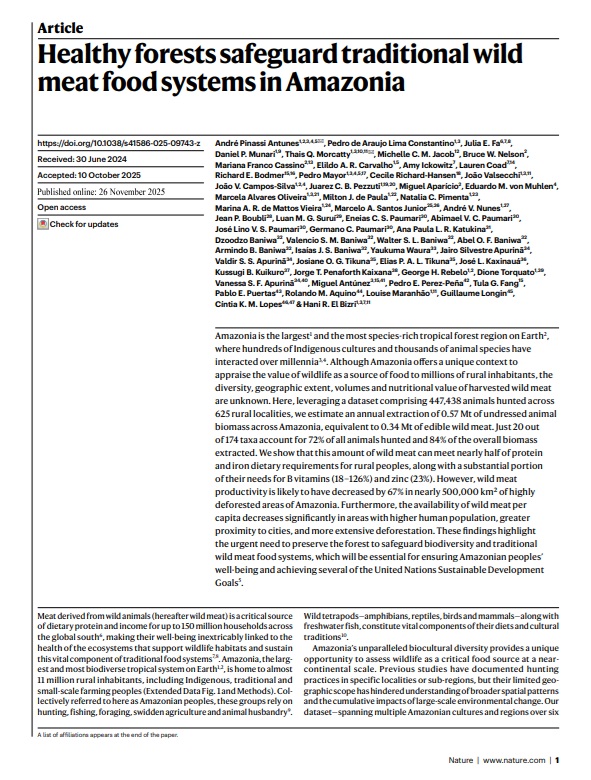
Antunes, A.P., Constantino, P.A.L., Fa, J.E., Munari, D.P., Morcatty, T.Q., Jacob, M.C.M., Nelson, B.W., .. Bodmer, R.E., Mayor, P., et al. (2025). Healthy forests safeguard traditional wild meat food systems in Amazonia. Nature, 648(8094), 625–633. DOI: 10.1038/s41586-025-09743-z.
Abstract
Amazonia is the largest and the most species-rich tropical forest region on Earth, where hundreds of Indigenous cultures and thousands of animal species have interacted over millennia. Although Amazonia offers a unique context to appraise the value of wildlife as a source of food to millions of rural inhabitants, the diversity, geographic extent, volumes and nutritional value of harvested wild meat are unknown. Here, leveraging a dataset comprising 447,438 animals hunted across 625 rural localities, we estimate an annual extraction of 0.57 Mt of undressed animal biomass across Amazonia, equivalent to 0.34 Mt of edible wild meat. Just 20 out of 174 taxa account for 72% of all animals hunted and 84% of the overall biomass extracted. We show that this amount of wild meat can meet nearly half of protein and iron dietary requirements for rural peoples, along with a substantial portion of their needs for B vitamins (18–126%) and zinc (23%). However, wild meat productivity is likely to have decreased by 67% in nearly 500,000 km² of highly deforested areas of Amazonia. Furthermore, the availability of wild meat per capita decreases significantly in areas with higher human population, greater proximity to cities, and more extensive deforestation. These findings highlight the urgent need to preserve the forest to safeguard biodiversity and traditional wild meat food systems, which will be essential for ensuring Amazonian peoples’ well-being and achieving several of the United Nations Sustainable Development Goals.
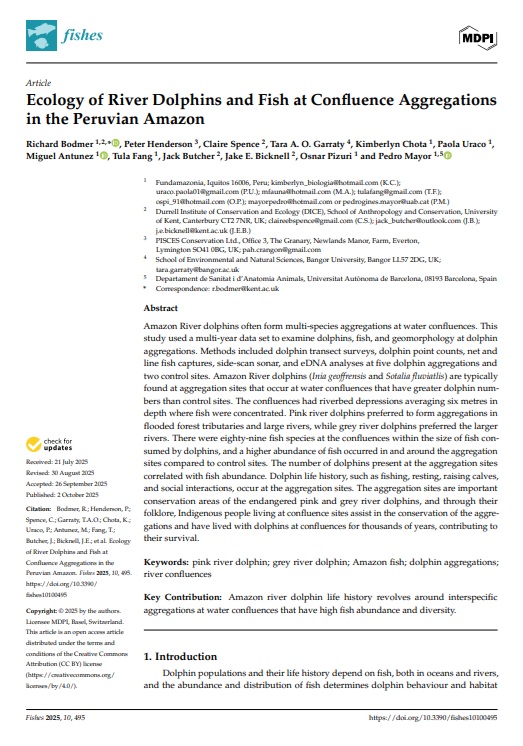
Bodmer, R.; Henderson, P.; Spence, C.; Garraty, T.A.O.; Chota, K.; Uraco, P.; Antunez, M.; Fang, T.; Butcher, J.; Bicknell, J.E.; et al. Ecology of River Dolphins and Fish at Confluence Aggregations in the Peruvian Amazon. Fishes 2025, 10, 495. https://doi.org/10.3390/ fishes10100495
Abstract
Amazon River dolphins often form multi-species aggregations at water confluences. This study used a multi-year data set to examine dolphins, fish, and geomorphology at dolphin aggregations. Methods included dolphin transect surveys, dolphin point counts, net and line fish captures, side-scan sonar, and eDNA analyses at five dolphin aggregations and two control sites. Amazon River dolphins (Inia geoffrensis and Sotalia fluviatlis) are typically found at aggregation sites that occur at water confluences that have greater dolphin numbers than control sites. The confluences had riverbed depressions averaging six metres in depth where fish were concentrated. Pink river dolphins preferred to form aggregations in flooded forest tributaries and large rivers, while grey river dolphins preferred the larger rivers. There were eighty-nine fish species at the confluences within the size of fish consumed by dolphins, and a higher abundance of fish occurred in and around the aggregation sites compared to control sites. The number of dolphins present at the aggregation sites correlated with fish abundance. Dolphin life history, such as fishing, resting, raising calves, and social interactions, occur at the aggregation sites. The aggregation sites are important conservation areas of the endangered pink and grey river dolphins, and through their folklore, Indigenous people living at confluence sites assist in the conservation of the aggregations and have lived with dolphins at confluences for thousands of years, contributing to their survival.
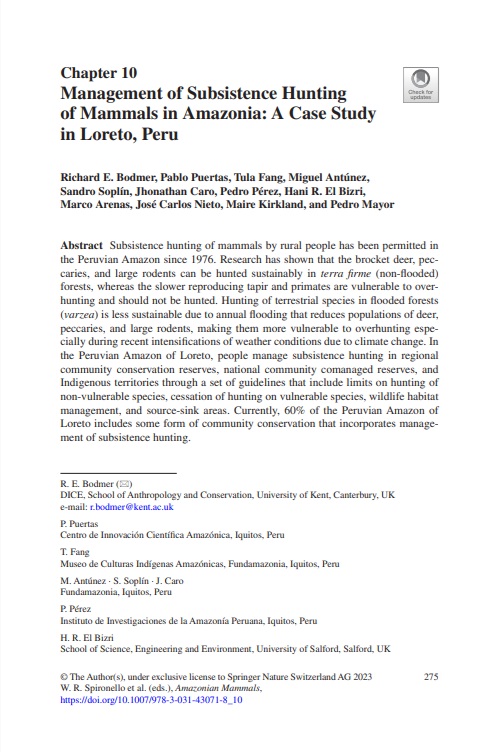
Bodmer, Richard, Pablo Puertas, Tula Fang, Miguel Antúnez, Sandro Soplín, Jonathan Caro, Pedro Pérez, Hani El Bizri, Marco Arenas, José Carlos Nieto, Maire Kirkland and Pedro Mayor (2023). Management of Subsistence Hunting of Mammals in Amazonia: A Case Study in Loreto, Peru. In: Spironello, W.R., Barnett, A.A., Lynch, J.W., Bobrowiec, P.E.D., Boyle, S.A. (eds) Amazonian Mammals. Springer, Cham. https://doi.org/10.1007/978-3-031-43071-8_10
Abstract
Subsistence hunting of mammals by rural people has been permitted in the Peruvian Amazon since 1976. Research has shown that the brocket deer, peccaries, and large rodents can be hunted sustainably in terra firme (non-flooded) forests, whereas the slower reproducing tapir and primates are vulnerable to overhunting and should not be hunted. Hunting of terrestrial species in flooded forests (varzea) is less sustainable due to annual flooding that reduces populations of deer, peccaries, and large rodents, making them more vulnerable to overhunting especially during recent intensifications of weather conditions due to climate change. In the Peruvian Amazon of Loreto, people manage subsistence hunting in regional community conservation reserves, national community comanaged reserves, and Indigenous territories through a set of guidelines that include limits on hunting of non-vulnerable species, cessation of hunting on vulnerable species, wildlife habitat management, and source-sink areas. Currently, 60% of the Peruvian Amazon of Loreto includes some form of community conservation that incorporates management of subsistence hunting.
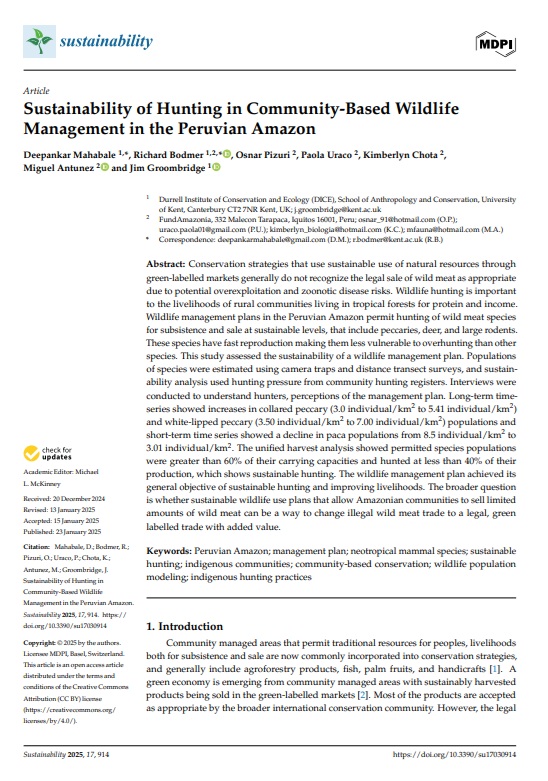
Mahabale, D.; Bodmer, R.; Pizuri, O.; Uraco, P.; Chota, K.; Antunez,M.;Groombridge, J. (2025). Sustainability of Hunting in Community-Based Wildlife Management in the Peruvian Amazon. Sustainability, 17, 914. https:// doi.org/10.3390/su17030914
Abstract
Conservation strategies that use sustainable use of natural resources through green-labelled markets generally do not recognize the legal sale of wild meat as appropriate due to potential overexploitation and zoonotic disease risks. Wildlife hunting is important to the livelihoods of rural communities living in tropical forests for protein and income. Wildlife management plans in the Peruvian Amazon permit hunting of wild meat species for subsistence and sale at sustainable levels, that include peccaries, deer, and large rodents. These species have fast reproduction making them less vulnerable to overhunting than other species. This study assessed the sustainability of a wildlife management plan. Populations of species were estimated using camera traps and distance transect surveys, and sustainability analysis used hunting pressure from community hunting registers. Interviews were conducted to understand hunters, perceptions of the management plan. Long-term timeseries showed increases in collared peccary (3.0 individual/km2 to 5.41 individual/km2 ) and white-lipped peccary (3.50 individual/km2 to 7.00 individual/km2 ) populations and short-term time series showed a decline in paca populations from 8.5 individual/km2 to 3.01 individual/km2 . The unified harvest analysis showed permitted species populations were greater than 60% of their carrying capacities and hunted at less than 40% of their production, which shows sustainable hunting. The wildlife management plan achieved its general objective of sustainable hunting and improving livelihoods. The broader question is whether sustainable wildlife use plans that allow Amazonian communities to sell limited amounts of wild meat can be a way to change illegal wild meat trade to a legal, green labelled trade with added value.
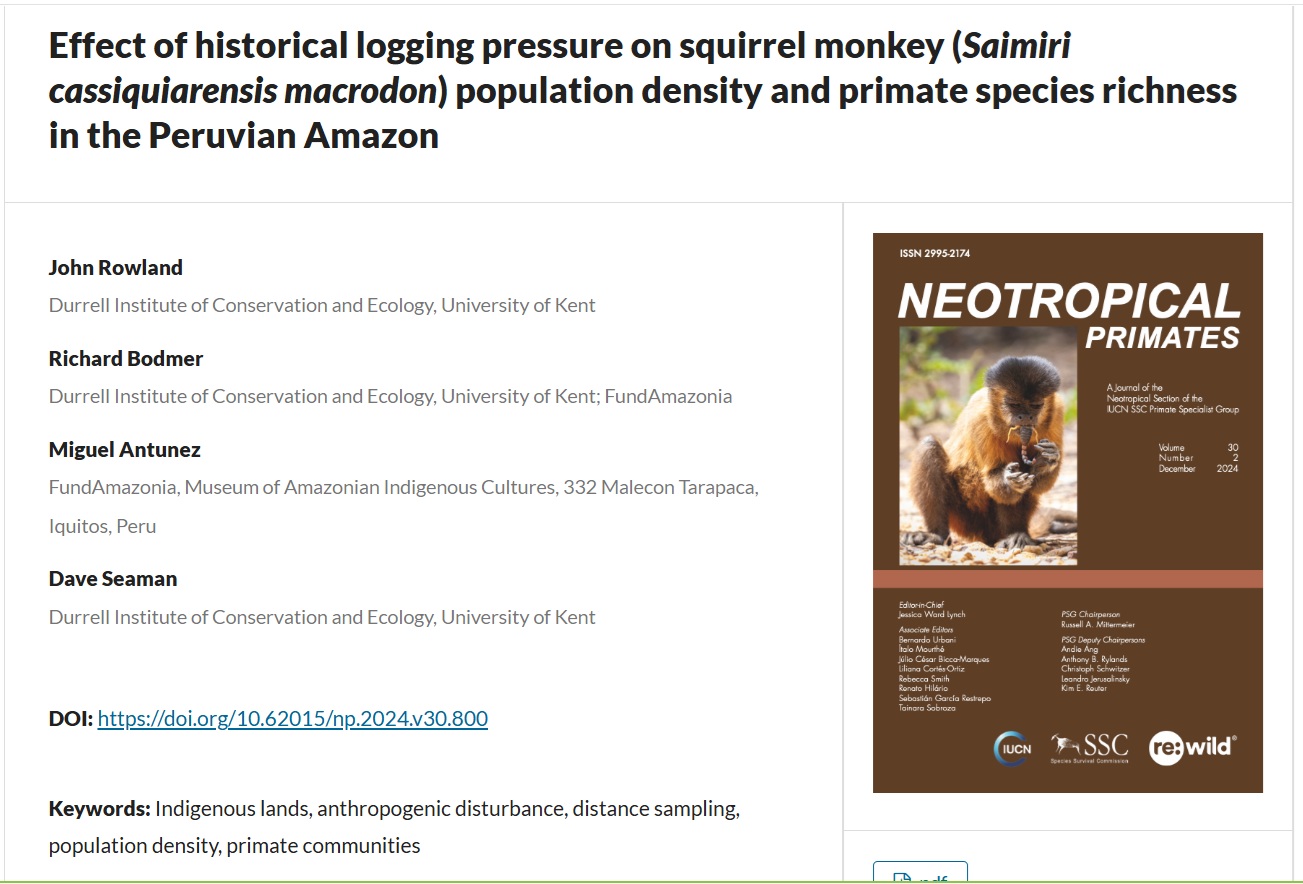
Rowland, J., Bodmer, R., Antunez, M., & Seaman, D. (2024). Effect of historical logging pressure on squirrel monkey (Saimiri cassiquiarensis macrodon) population density and primate species richness in the Peruvian Amazon. Neotropical Primates, 30(2), 19-27. https://doi.org/10.62015/np.2024.v30.800
Abstract
Primates in the Amazon are threatened by the expansion of human activities, including logging. Here, we investigate how primate communities are affected by different forest use and disturbance histories in two adjacent indigenous territories. We assess how logging in the recent past has changed primate community composition. One of the territories was protected from selective commercial logging activities, whilst the other had decades of selective logging before starting the process of becoming an indigenous territory in 2012. The past logging has left forest gaps and secondary forests, and was accompanied by small agricultural plots. Using line transect surveys and distance sampling analysis, we compared primate species richness between the two territories, and the density of the ecologically dominant squirrel monkey species, Saimiri cassiquiarensis macrodon. Villa Belén, the territory with more recent and more intense logging supported a higher population density of squirrel monkeys (192 indiv./km2) than Jaldar (107 indiv./km2), the territory with a less intense and more distant logging history. We found no difference in squirrel monkey group size between the forests of Villa Belén and Jaldar. Primate species richness declined as logging pressure and anthropogenic disturbance increased with an estimated richness of seven primate species in Villa Belén, compared to 11 primate species in Jaldar. Our findings suggest that squirrel monkeys can persist in tropical forests with high levels of historical logging pressure and at greater densities than in less disturbed areas with higher overall primate species richness.